Easy 4th Grade Math Long Division Problems
Frequently Asked Questions:
Q1: How do you solve division problems?
Ans:To solve division problems, we read the problem and identify the dividend and the divisor. Then, we divide the dividend by the divisor either mentally or by using long division method. We may also need to1 solve the problem further to get to the final answer.
Q2: How do you teach division in 4th Grade?
Ans:Distributing something fairly into equal groups is called division.The first introduction to division will be sharing groups of objects into equal groups and teaching how to write division sentences. For example; dividing 12 items among 4 persons equally is a share of 3 with each which can be mathematically expressed as 12 ÷ 4 = 3. Then the children should be taught that division and multiplication are inversely related. This is followed by teaching how to divide large numbers through standard division algorithm.
Q3: What is a division fact for 4th Graders?
Ans:Division facts are the division number sentences related to times tables. Therefore: 30 ÷ 3 = 10, 27 ÷ 3 = 9 and 24 ÷ 3 = 8 are all division facts for the three times table. By the end of year 4, children need to know all of their times tables up to 12 x 12, and the corresponding division facts.
Q4: What is a remainder in a division problem?
Ans:A remainder in a division problem is the number obtained after dividing the number i.e the dividend by its divisor. In other words, remainder is the difference between the multiple of divisor which is closest to the dividend and the dividend. For example; to divide 24 by 7, the multiple of 7 closest to 24 is 21. So, remainder is 24 - 21 = 3.
In the previous grade, kids learn the basic approach to dividing numbers. The concept is introduced by distinct models with special focus on the visual observation skills to subtract or group objects for the division. With proficiency in dividing 2-digit numbers by 1-digit number through short division, kids learn to solve math expressions with a division operator (symbolized by a "forward" slash, straight line/bar, and Obelus signs).
In grade 4, kids learn about long-division and other methods in detail to obtain a quotient and the remainder upon division. The corresponding math skills such as the representation of numbers up to 2 decimal places and word problems on measurement are instrumental in nurturing the math prowess with the practice of "division".
What is "Division"?
"Division" for the 4th graders is defined as:
"Separation or partitioning of objects from a set for an equal share without any disparity in the fixed number of groups".
The resultant will be a whole number quotient and a remainder if the number is not divisible further.
For example:

Math Games for Teaching Division
Achieving proficiency in basic math skills (addition, subtraction, multiplication, and division) is one of the paramount steps to teach other math concepts to kids. Interactive fun learning games to teach math concepts are proven eclectic for home schooling and as a homework help for kids.
Designed by math experts as per the guidelines of common core math standards, SplashLearn fun games are acclaimed to foster fast math in kids.
1. Learning & outcome:
In the previous grade, kids learn the concepts and basics of the math operation "division" using different operators and distinct models of the division. In grade-4, the math skills are further honed to divide numbers up to 10,000 by a single-digit number. Also, the representation of the result in the form of a quotient and a remainder is introduced to understanding the process of "division" in details.
Following are the projected learning outcomes:
- Understanding the process of long division step-by-step to divide 2, 3 and 4-digit numbers by a single-digit number
- Recording the division result in the form of a quotient and the remainder
- Comprehending division by multiples of 10 & 100
- Translating word problems in reasonable math expressions using numbers and math operators for addition, subtraction, multiplication, and division for multi-step computation
2. Required math skills:
To learn division of numbers comprising 2-digits and more, essential math skills are operations like addition, subtraction, and multiplication. The subtraction skills for numbers up to 4-digits along with a hands-on knowledge of the multiplication-tables to perform short division is helpful to compute the numbers quickly. Also, the comprehension of numbers in base 10 blocks is used for fast math.
3. Engagement:
The comprehensive worksheets for SplashLearn are designed to boost confidence and propel fast math skills in kids. With an engaging interface offering a theme-based learning environment, kids experience higher engagement and inquisitiveness to remember the concepts fairly. Crisp word problems to stimulate methodical thinking and build logical solution result in developing accurate & fast math skills
Long Division Method
The long division method is useful in learning division of larger numbers. The process of long division has repeated steps. These steps are division, multiply and subtract, construct a new number by dropping down the digit and repeated division till the remainder is left to zero or the number is not divisible further (remainder).
If the remaining number is not divisible by the divisor, then the number is always less than the divisor and is recorded as the remainder.
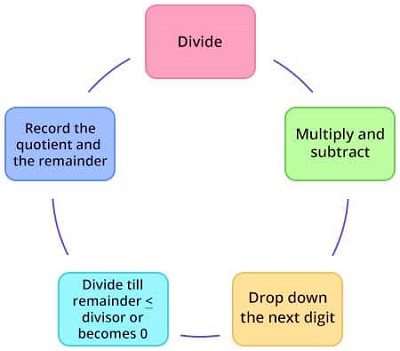
For example, divide 352 by 4

Using long division methods, numbers are divided by a 1-digit number.
Division by Zero (0)
Division by 0 is an undefined value. As there exists no number, which multiplied by 0 gives an integer or fractional value. Thus, the arithmetic expression holds no meaning. For example 25 ÷ 0 = Not defined
Upcoming sections illustrate the division examples for different numbers.
Divide 2-digit number by 1-digit number
To divide a 2-digit number (between 10 to 99) by a single digit number (between 1 to 9), two cases are possible. Either the answer will be quotient without a remainder or with a remainder. The remainder, in any case, will always be less than 10.
Division without remainder
The division of a 2-digit number by 1-digit number can be understood using the following examples.
- Divide 65 by 5

So, the problem can be written as 65 ÷ 5 = 13
- A box of pens has 72 pens. Divide the pens equally among 3 students so that each one of them gets an equal number of pens.
- Dividend = The total number of pens (72)
- Divisor = The total number of students (3)
- The division equation is: 72 / 3
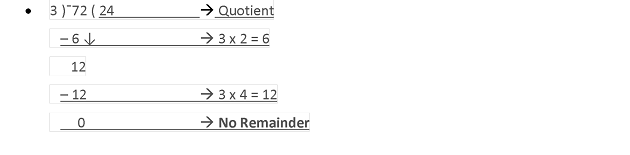
Thus, each student will get 24 pens upon distribution.
Division with remainder
In this case, a 2-digit number is divided by a single-digit number (between 1 to 9). The resultant remainder might not be a zero, which means the given number of objects can't be divided equally into the given number groups.
- Divide 70 by 3
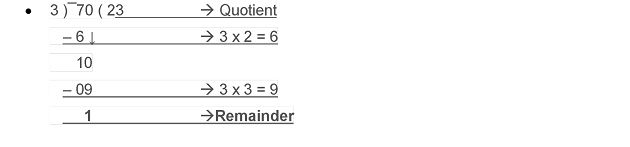
So, the problem can be written as 70 / 3 = 23 and remainder 1
- Jim has got a bunch of 90 colorful cards. Divide the cards equally among 6 friends (including Jim).
- Dividend = Total number of cards (90)
- Divisor = Total number of friends (6)
- The division equation will be = 90 / 6
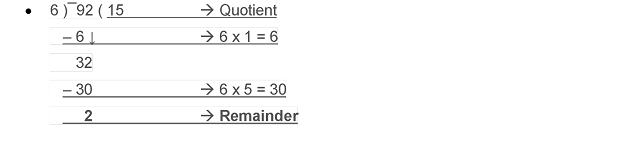
Thus, each friend will get 15 cards and 2 cards will be left at the end.
Divide 3- digit number by 1-digit number
Using the division skills for two-digit numbers by a single-digit number (between 1 to 9), division of 3-digit numbers (between 100 to 999) can easily be performed in the same manner.
Division without remainder
In order to divide a three-digit number by a number between 1 to 9, initiate the long division method with repeated division, multiplication & subtraction followed by pulling down the remaining digits in a number.
For example:
- Divide 620 by 4

So, the problem can be written as 620 ÷ 4 = 155
Division with remainder
To divide a 3-digit number by a single digit number, follow the same method of long division. It may happen that the number can't be further divided by the divisor. Hence, the number is recorded as the remainder with the calculated quotient.
For example, a bag of candies has 115 units. Distribute them among 8 friends so that each one of them gets an equal number of candies.
- Dividend = The total number of candies (115)
- Divisor = The total number of friends (8)
- The division equation will be = 115 / 8
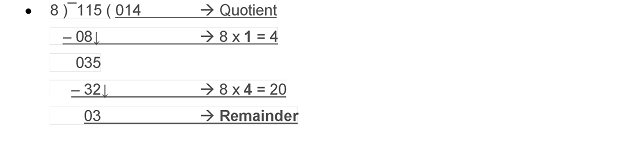
Thus, each of the friends will get 14 candies. 3 candies will be left at the end.
Divide 4-digit number by 1-digit number
The division skills further advance to the division of 4-digit numbers (between 1000 to 9999). The method of division remains same. Long division, as well as multiplication tables, are helpful to perform division quickly.
Division without remainder
To divide a 4-digit number with a single-digit number, follow the long division method. Alternatively, divide the number by direct multiplication and subtraction as illustrated.
For example, divide 1257 by 3
- 1257 / 3
-
 → 124 51 279 / 3 ➔ 419
 - The steps involved are:
- Divide 12 by 3, record the quotient 4
- Divide 5 by 3, record the quotient 1 and remainder 2
- Append the previous quotient by 1 making it 41
- Append the "remainder" 2 by 7, and divide 27 by 3
- Append the previous quotient by 9 making it 419
- To cross check the result, multiply the quotient 419 by 3
- 419 x 3 ➔ 1257
Division without remainder
To divide a 4-digit number with a single-digit number, which may result in a quotient and a remainder≠0; follow the same method of long division or short division.
For example, a bunch of sticks has 4251 sticks. Divide the sticks into equal groups in 9 boxes to pack them separately.
- Dividend = 4251 (Total number of sticks)
- Divisor = 9 (Total number of boxes)
- The division equation will be: 4251 ÷ 9

Thus, each box will have 472 sticks. 3 sticks will be left at the end.
Divide multiples of 10, 100
To divide multiples of 10 and 100 (such as 90, 250, 300, 900, 5000 etc), by a single digit number; knowledge of base 10 blocks is extremely helpful.
For example, to divide 90 by 3; consider 90 as 9 "tens". Now, divide 9 by 3 using short division or any other methods. Multiply the result by the figure 10 to obtain the quotient.
- 90 / 3 ➔ 9 "tens" / 3
- 9 / 3 → 3
- So, 90 /3 ➔ 3 x 10
- Thus, 90/3 = 30
In the same manner, a number like 2500 can be framed as 25 "hundreds" or 250 "tens".
To understand the process, divide 3240 by 9. Consider the number as 324 "tens". Follow the division technique of dividing a 3-digit number by a single-digit number.
- 3240 / 9 → 324 "tens"
- 323 546 / 9 → 36 x 10
- Thus, 3240 / 9 = 360
For dividing a multiple of 100, such as 600 by 2; consider the number as 6 "hundreds". Divide 6 by 2 using short division.
- 600 / 2 → 6 "hundreds"
- 6 / 2 → 3 x 100
- Thus, 600 / 2 = 300
Multiple of 10 and 100 can be divided by a single digit number only if the remainder is 0. In later grades, the division can be performed by applying the suitable place value of decimal to divide.
Application
As a step next to basic division, grade-4 math skills focus on developing advanced division skills to solve word problems. Kids further learn to deduce mathematical expressions with multiple math operators and dividing numbers into given groups. Also, computation of the remainder enhances writing a logical answer for the word problems. Division skills, in particular, are essential for learning different types of measurement (such as time, length, capacity & weight) and data representation in the later grades.
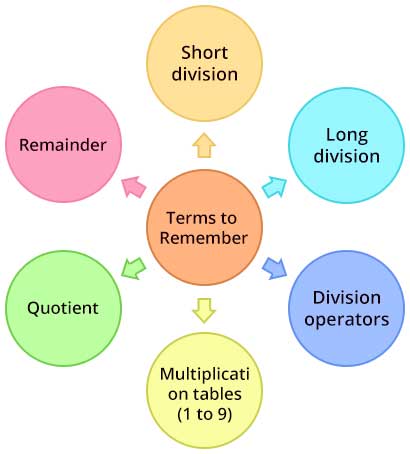
Terms to Remember
SplashLearn Division Games Worksheet
The math operation "division" is a fundamental skill to learn the subject. With advanced concepts such as the application of multiplication to form tables and division of 4-digit numbers by single-digit numbers, fluency in abstract thinking and reasoning is established. Kids learn to translate complex word problems in math expressions pertaining to the classification and arrangement of objects in different groups.
SplashLearn learning games serve as brain teaser games for kids to instigate fast math skills. With the engaging interface and comprehensive curriculum aligned to common core math standards, foster math skills, and advanced division concepts during summer vacation and homeschooling.
Source: https://www.splashlearn.com/math/division-games-for-4th-graders

Post a Comment for "Easy 4th Grade Math Long Division Problems"